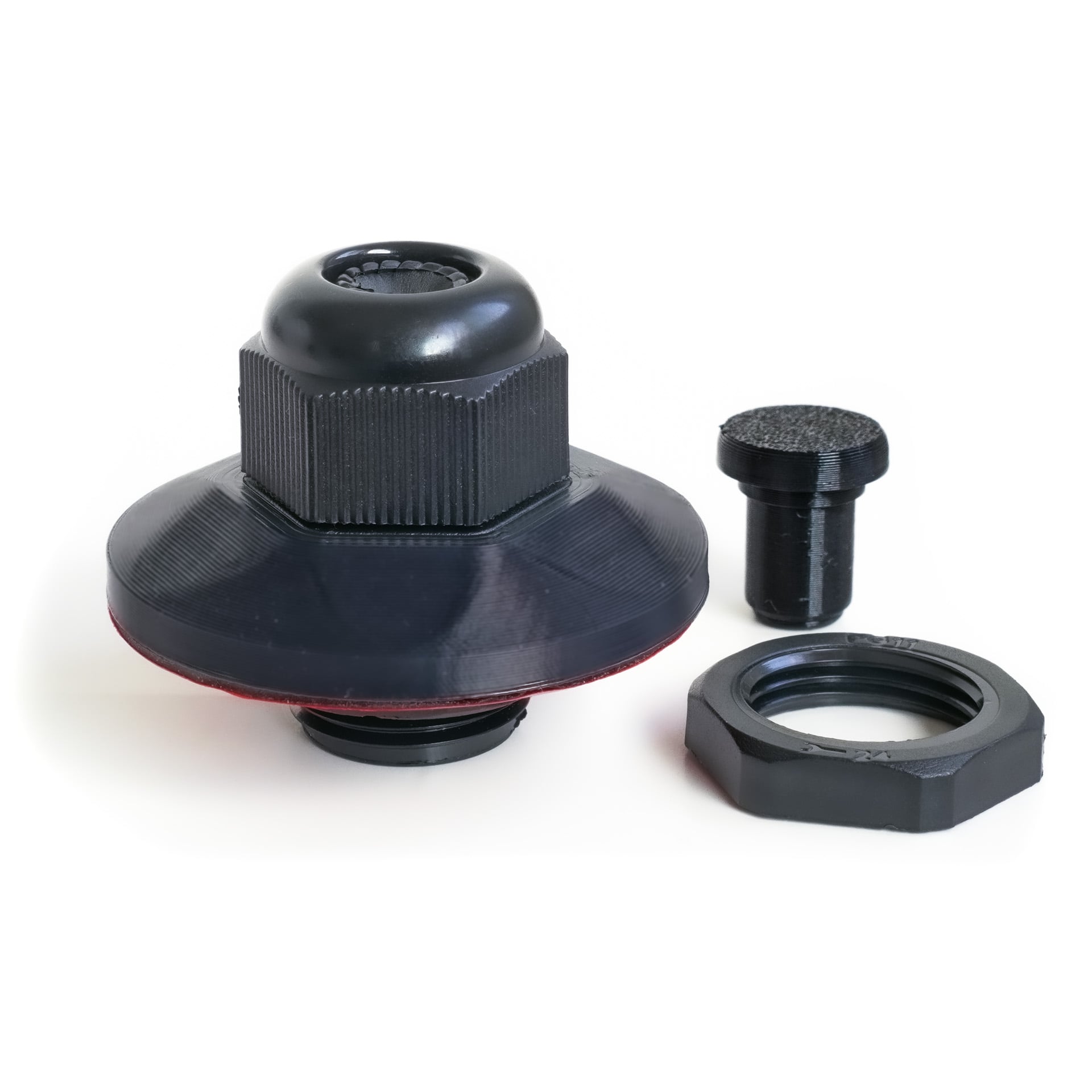
The Ford Transit has several pass-through holes hidden below some of the roof plugs, located as follows (marked as #2): * NOTE: We don’t recommend using the last row of pass-trough holes located at the very back of the Transit with our Cable Entry Pad, because there is not enough space to install the lock nut from inside the van (see step 2). Use this Cable Entry Pad in any of the Transit’s factory pass-through holes to create a waterproof entry point for a single cable (solar, weBoost antenna, LED, etc.): WeBoost Antenna Solar Panels The Cable Entry Pad is secured with VHB tape AND a lock nut. The lock nut compresses the VHB tape and creates a waterproof, permanent bond with the roof. An IP68-rated cable gland provides the seal with the cable. Installation 1. Remove The Roof Plug You can start with a plastic scraper, it’s a bit easier to get the plug to go at first: Pull to remove the plug completely and clean the sealant left behind with isopropyl alcohol: All clean! The Cable Entry Pad will cover the primed surface: 2. Install The Cable Entry Pad Unscrew the lock nut from underneath the pad and put aside: Peel off the release film from the VHB tape: Make sure the surface is still clean and apply pressure for 5-10 seconds: Install the lock nut inside the van, hand-tight firmly with your fingers then use a socket to add about one extra turn (do not use tools and overtorque, this will damage the plastic threads) : 3. Install The Cable Unscrew the sealing nut from the gland (without removing it) and route the cable through the gland (the WeBoost cable and connector fit through the 6.5-10.2mm PG11 gland, as shown below): For solar you will have to trim the existing MC4 connector, route the cable, then install a new MC4 connector. It’s easier than it sounds and we documented it in our Solar Panels Installation. Screw the sealing nut (hand-tight, but firmly) to create a waterproof joint: At this point the installation is waterproof, but you may choose to add a bead of sealant around the pad/cable for your peace of mind. Optional: Temporary Plug Not quite ready to route the cable? That’s OK! You can use our Temporary Plug until you’re ready for the final installation: Loosen the sealing nut and insert the plug: Screw the sealing nut to make a waterproof joint: Starlink Mini You can use a 4-8mm Cable Entry Pad with a Direct Battery Power Cable to power the Starlink Mini dish. The Starlink connector does NOT fit through the gland; the cable must be trimmed. As documented: Starlink Mini Installation WeBoost We developed the Cable Entry Pad when installing our motorized tilting weBoost antenna. You might be interested in reading the full write-up: Motorized Tiling weBoost Antenna Solar We also used Cable Entry Pads for our solar panels: Solar Panels Installation Compatibility Van Models: Ford Transit (2015-Present). Cable Profile: Round (not flat). Specifications Outside Dimensions: 1.78in diameter x 1.52in height (45mm x 39mm). Materials: Pad: ASA (Acrylonitrile styrene acrylate). Gland: Nylon. Seal: TPU. Self-Adhesive: 3M VHB Tape. Temperature Resistance: Up to 221F (105°C). UV Resistant. Shipping Ships From: British Columbia, Canada. Carrier: Canada Post / USPS. Cost: Actual carrier shipping rate calculated at checkout. You can combine other items from our Store to save on shipping. wARRANTY, rETURNs & Refund Warranty: If there is an issue or manufacturing defect, we’ll be happy to send you another one free of charge! �� Returns & Refund: You are responsible of shipping the product back to us (including the shipping fees associated with it) for the following reasons: Ordered by mistake or if you changed your mind. Incompatibility (please check “Compatibility” section before ordering). ABOUT THIS PRODUCT Do It Yourself. We wanted a better cable entry point for the Ford Transit, so we made one. This is an homemade product. Each Cable Entry Pad is individually 3D printed and assembled by us. This is not a mass-produced product. This is a crafted, hand-made product. Low Volume. We created this product for our own needs, to make just a few units. There is no way for us to ramp up the production and lower the price, unless we take it to injection molding manufacturing but that’s a whole another level we’re not considering at the moment.